


The Hidden Challenge of Slow, Intentional Movement
- Lauren Matthews
- Jun 25
- 4 min read
How slowing down changes muscle recruitment, control, and coordination
Fast movement often feels easier. Momentum carries you through. Strength fills in the gaps. Coordination issues can go unnoticed.
This is why people are often surprised when a slow Pilates exercise feels more challenging than something dynamic or high intensity. Slowing down removes the shortcuts. It asks the body to generate and control force continuously rather than relying on speed.
As a Pilates instructor, I use slow movement intentionally—not to reduce challenge, but to change how the muscles and nervous system are working.
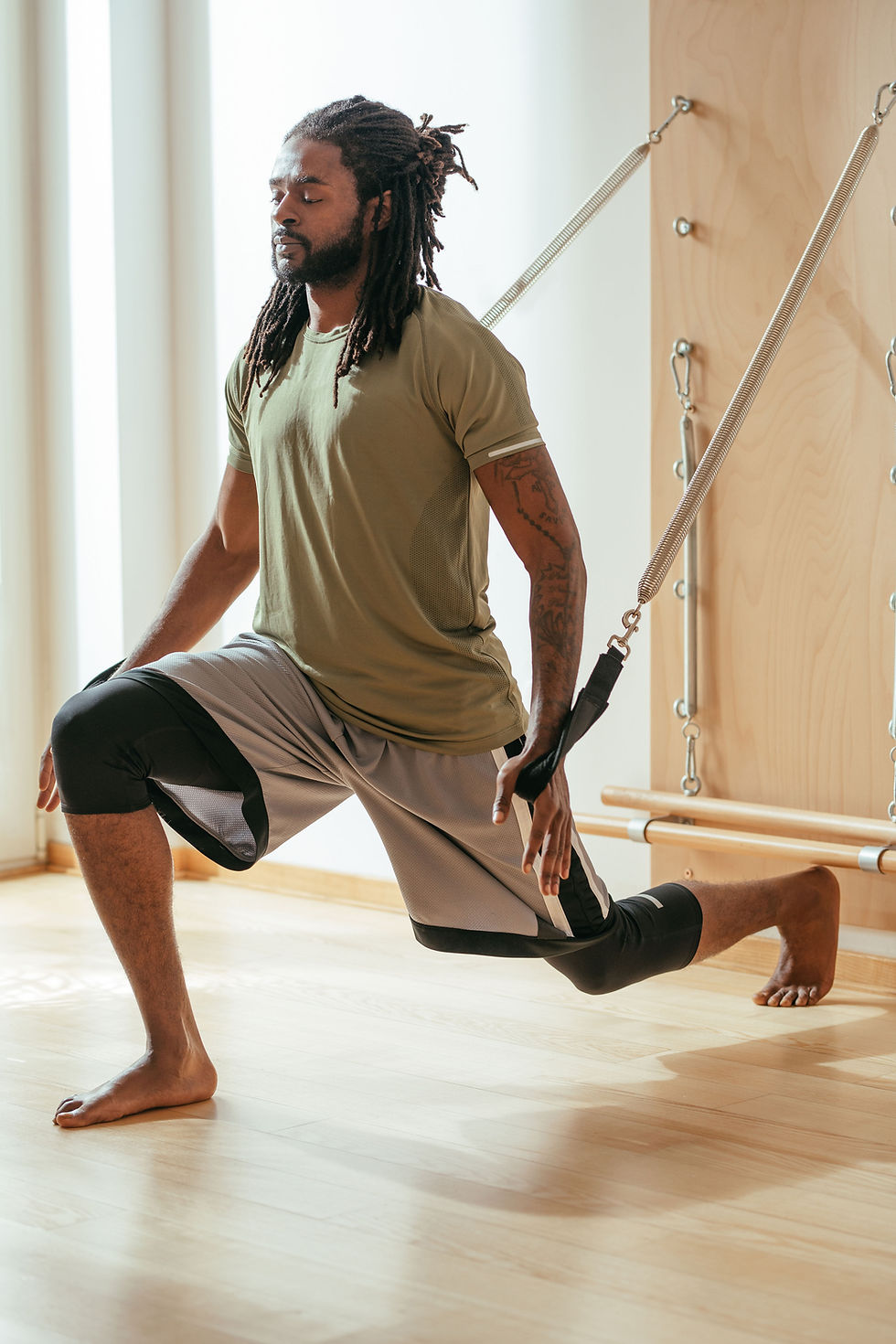
How Fast Movement Can Hide Compensation
Fast movement allows the body to rely on momentum and elastic recoil. Muscles can fire briefly and then coast while joints move through range.
Even when alignment is off or support is missing, the body can often push through using larger, more dominant muscle groups. Strength and speed mask instability.
The movement looks strong, but underlying coordination issues may go unnoticed.
Over time, these compensations can contribute to joint irritation, overuse patterns, and chronic tension. The body is completing the task, but not distributing load well.
What Slow, Intentional Movement Demands From the Muscles
Slow movement changes the way muscles are asked to work.
Without momentum, muscles must generate force steadily and maintain it throughout the movement. This increases time under tension, requiring sustained engagement rather than quick bursts of effort.
Stabilizing muscles are also more active during slow movement. They must continuously manage joint position and respond to subtle shifts in load. Rather than turning on and off, the system stays engaged and adaptable.
This is why slow movement often feels more demanding, even when the load is lighter.
Why Slow Movement Feels So Challenging
Slowing down increases demand on proprioception, motor control, and coordination.
The body can’t rush past weak links. Transitions become just as important as end positions. Muscles must lengthen and shorten under control, rather than snapping from one position to another.
This requires precise timing between muscle groups. When that timing is off, the effort feels harder and less efficient—not because the movement is wrong, but because the system is being asked to organize itself more completely.
In Chinese medicine, ease is associated with smooth flow. When movement slows and flow feels disrupted, it often reveals where the system is working against itself rather than sharing load.
Speed Masks Neuromuscular Inefficiency
Fast movement favors large, powerful muscles and rapid firing patterns. Smaller stabilizers may contribute less, while joints rely on speed for support.
This can create the illusion of strength while limiting resilience. Over time, tissues take on forces they aren’t designed to manage repeatedly, and adaptability decreases.
Slowing down shifts demand toward coordination and control, forcing the nervous system to refine how muscles work together rather than simply producing force.
How I Use Slow Movement in Pilates
I don’t slow movement down to make it difficult for the sake of difficulty. I slow it down to change the quality of muscular work.

In Pilates sessions, slow movement allows me to observe how muscles engage under load, how alignment is maintained through transitions, and how breath supports force production. It also allows clients to feel whether they’re stabilizing efficiently or gripping unnecessarily.
Once clarity improves, speed and complexity can be reintroduced without losing organization.
Slow Movement Builds Strength the Body Can Use
Slow movement builds strength that is coordinated rather than isolated.
Because muscles are working longer and with more precision, strength developed this way tends to be more transferable. It supports balance, joint health, and endurance rather than just peak output.
This is especially important for people recovering from injury, managing pain, or wanting strength that holds up under real-life demands.
What Happens When Movement Is Always Rushed
When movement is consistently rushed, the nervous system stays in a reactive state. Muscles fire quickly but inconsistently. Stabilizers fatigue early. Precision drops.
Progress often plateaus. Pain patterns return. The body feels busy but not necessarily strong.
Introducing slower movement gives the nervous system time to recalibrate motor patterns and improve how force is managed across the system.
Intentional Movement in a Fast-Paced World
We live in a culture that rewards speed. Faster workouts. Faster results. Faster transitions from one task to the next.
Intentional movement offers a counterbalance to that pace. Not by resisting it, but by teaching the body how to stay organized within it.
When movement is practiced with attention—whether slow or fast—the nervous system learns how to remain present under demand. Muscles coordinate more efficiently. Effort is distributed more intelligently. The body becomes less reactive and more responsive.
This quality of attention often carries into daily life. People notice when they rush unnecessarily. They sense when tension creeps in. They make small adjustments before strain accumulates.
Intentional movement doesn’t require life to slow down. It teaches the body how to move well even when things are moving quickly.

Final Thought: Slow Movement Refines Strength
Slow movement isn’t about doing less. It’s about demanding more precision.
By increasing time under tension, improving coordination, and requiring continuous control, slow movement challenges the muscles and nervous system in ways speed cannot.
This is why slow movement is such a powerful part of Pilates. It doesn’t just build strength—it teaches the body how to use it well.

Lauren Dalke is a STOTT-certified Pilates instructor with over 15 years of experience, specializing in private sessions that integrate biomechanics, functional strength training, and nervous system–informed movement. She is the founder of LDV Pilates in Mar Vista, CA.


Comments